
Cellulose from the Sea
To a food scientist, cellulose is familiar territory. It thickens, suspends, binds water and adds body across thousands of products, and it turns up on labels as “cellulose gum,” “microcrystalline cellulose” or simply “plant fibre.” Nearly all of it comes from the same few places: wood pulp, cotton and the fibrous parts of land crops. Cellulose from the sea — from kelp and other large seaweeds — is chemically the same polymer, yet it is rarely evaluated as a food ingredient. It is worth a closer look, because — for reasons written into its structure — it does not behave like the terrestrial kind.
The reason is that what cellulose does in a food depends very little on the molecule and almost everything on how it is built. The molecule itself is the same everywhere — long chains of glucose, the ordinary sugar plants make. What changes from one source to another is the architecture assembled from those chains: how tightly they pack, how large the fibres they form grow, and what those fibres are bound to in the cell wall. That architecture is fixed by the organism. Kelp assembles its cellulose differently from a pine tree or a cotton boll, and the differences can be measured.
THE WAY THE CHAINS PACK
Cellulose chains never work alone. They line up side by side and bundle into microscopic threads, called fibrils, and it is these fibrils — their internal packing, their length and their thickness — that do the ingredient’s job in a food. Within each fibril, the chains lock together into an orderly, crystal-like grid. That grid can take one of two forms — one looser and more chemically reactive, the other tighter and more settled (chemists call them Iα and Iβ respectively).
The mix differs sharply by source. In wood, the tighter Iβ form dominates, at about 70 per cent of the total. In kelp the balance is close to reversed, with the looser Iα form making up roughly three-quarters of Laminaria spp.1 Kelp cellulose is also more crystalline overall — its chains are packed more regularly and more completely — which is typical of seaweed cellulose.2
THE SIZE OF THE FIBRE, AND WHAT HOLDS IT
The fibres differ in size and setting as much as in packing. Land plants build extremely fine fibrils — just two or three nanometres across, where a nanometre is a millionth of a millimetre — and set them inside lignin, the stiff natural cement that makes wood hard and holds it together.3 Kelp builds larger, flatter, more ribbon-like fibrils, several times wider at roughly ten to twenty nanometres across, and does so without any lignin.4
Two things follow. Longer, more elongated fibrils tangle into a mesh far more readily — the way long strands of cooked spaghetti knot into a single mass while short grains of rice slide past one another — and that mesh is what physically traps particles or gives a food its structure. And because kelp cellulose is not cemented into lignin, freeing it into usable fibres does not require the aggressive chemical and mechanical treatment that wood cellulose needs; it comes apart with a fraction of the energy.1
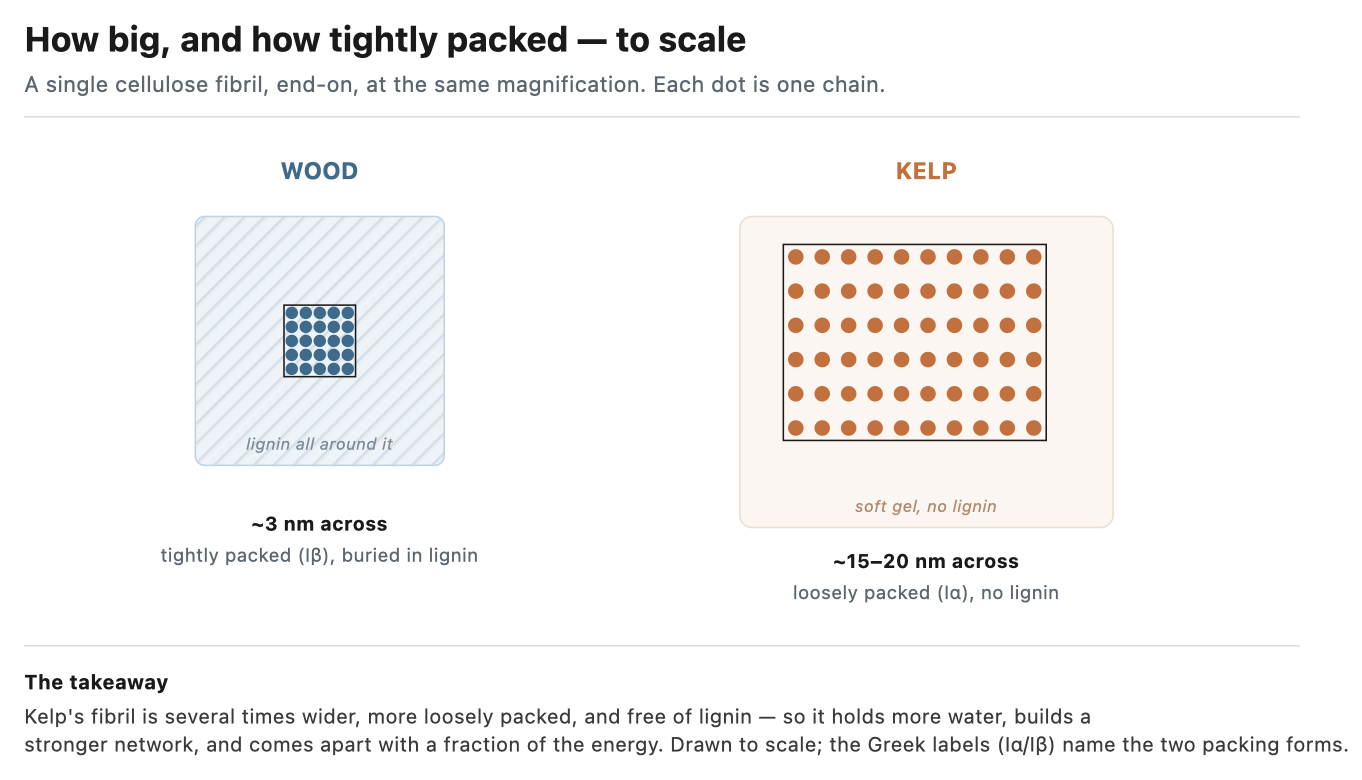
Figure 1. The same fibril from wood and from kelp, drawn to scale and seen end-on (each dot is one cellulose chain). Wood’s fibril is about 3 nanometres across, tightly packed (Iβ) and buried in lignin; kelp’s is several times wider — roughly 15–20 nanometres — loosely packed (Iα) and free of lignin.
None of this is confined to diagrams. Isolate the fibrils from an algae and from wood, put them under an electron microscope, and the algal fibril is visibly thicker and more sharply defined than wood’s fine, tangled web.5
WHAT THE STRUCTURE DOES
These structural differences translate into practical ones. Measured directly against wood-derived cellulose, kelp cellulose holds more water, forms a stronger internal mesh, tolerates heat better, and can be reduced to its working form using around a tenth of the mechanical energy.1 Binding water, building structure, surviving heat and processing gently are precisely the properties a formulator wants from an ingredient of this type.
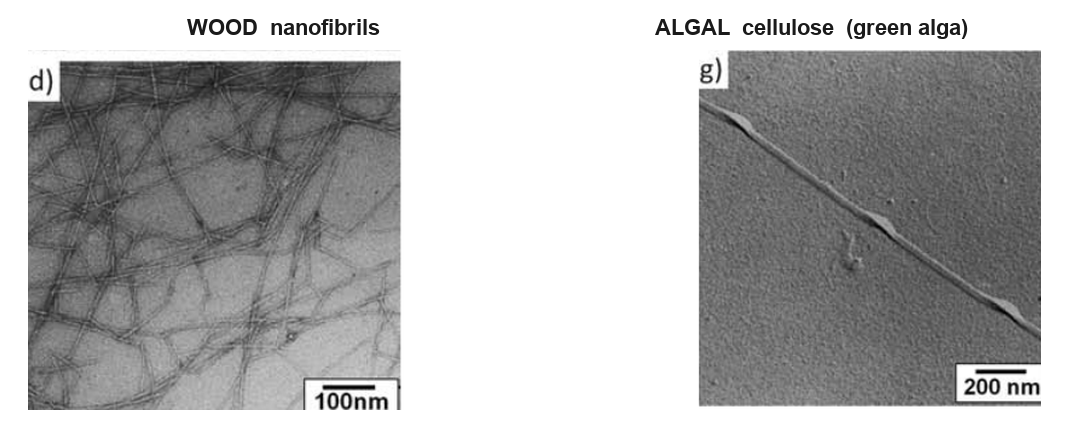
Figure 2. The contrast under an electron microscope. Left: wood nanofibrils — a fine, tangled web of thin threads (scale bar 100 nm). Right: a single algal cellulose fibril — far thicker and more rigid (scale bar 200 nm). The algal sample here is a green alga, the textbook exemplar of marine cellulose; kelp (a brown alga) shares the same coarser, more crystalline character. Credit — Moon et al., Chemical Society Reviews 40 (2011), Fig. 9 (panels d, g); © Royal Society of Chemistry, reuse requires permission.
IN THE GLASS
Beverages are where the evidence is clearest, and where the contrast with wood cellulose is easiest to see. Three familiar cases where cellulose is deployed:
— A high-protein shake. Protein particles and added minerals tend to settle or clump over time, especially after heat treatment. A cellulose mesh holds them evenly dispersed through months of shelf life instead of letting them fall to the bottom.
— A chocolate or cocoa drink. Cocoa solids are dense and sink without something to suspend them; the fibril network keeps them in place so the last sip looks like the first.
— A plant-based milk. Oil droplets and fibre have to stay dispersed rather than creaming to the top — the fibrils both build a suspending network and sit at the oil–water boundaries.
In each case the cellulose works two ways at once: it forms an invisible three-dimensional scaffold that traps particles throughout the liquid, and it gathers at the boundaries between oil and water to keep droplets from merging — rather than simply making the drink thicker.6 The longer and thinner the fibril, the more readily it knits into this kind of load-bearing network.6
Measured side by side, the kelp version outperforms the wood-derived one on exactly the counts described above, and takes roughly a tenth of the energy to prepare.1 The pull of the source structure shows even between two land plants: cotton-derived fibrils, which are more crystalline than wood, resist being broken down and behave differently for exactly that reason7 — a smaller version of the gap that separates kelp from wood. And it is not only a laboratory measurement: kelp nanofibrils have been used to stabilise real oil-in-water emulsions and hold them against separation in storage6 — the same task wood-derived cellulose performs, now carried out by the marine material.
IN THE OVEN
Baking is the natural next question, and the logic runs the same way. The two properties that make kelp cellulose effective in beverages — holding water and holding up to heat1 — are the same two that govern how a dough takes up water, how a crumb sets in the oven and how slowly bread goes stale. A fibre that binds more water and keeps its structure at baking temperatures should improve moisture retention and extend softness more effectively than the wood- and crop-based celluloses bakers use today. This is a promising application area; further formulation studies are needed to confirm that kelp cellulose provides superior performance in real bakery systems.
WHERE WOOD CELLULOSE WINS
Kelp cellulose is also a relative newcomer, and there are jobs the wood-derived material simply does better — for reasons that follow the same structural logic in reverse. Where a formulation needs a rigid, dry, free-flowing powder rather than a water-binding network — as a bulking agent, an anti-caking agent, or a tablet binder that compresses into a hard solid — the stiff, finely divided wood particle is the right tool, and kelp’s water-loving, gel-forming fibrils would be a liability. Microcrystalline cellulose is valued precisely for its compressibility and binding in these roles, and among the common sources the wood-derived grades give the highest mechanical strength.8 The rule holds in both directions: structure decides the job. Iα-rich kelp cellulose is built to hold water and build networks; Iβ-rich wood cellulose is built to stay rigid and keep its shape.
A MATERIAL WORTH UNDERSTANDING ON ITS OWN TERMS
For decades, food makers have chosen their cellulose by grade, price and particle size. The crystallography suggests that was a missed variable. A wood fibre is stiff, finely divided and locked in lignin; a kelp fibre is looser-packed, larger and free — and those differences carry all the way through to how much water it holds, how strong a network it builds, and how well it survives heat. None of that makes kelp cellulose the right answer everywhere. It makes it a genuinely different tool, and one the food industry has barely begun to pick up. As the pressure for ingredients that perform better and source better keeps building, the cellulose grown in the sea starts to look less like a stand-in for the kind milled out of wood, and more like a material worth understanding in its own right.
SOURCES
1. Onyianta, A. J., et al. “High aspect ratio cellulose nanofibrils from macroalgae Laminaria hyperborea cellulose extract via a zero-waste low energy process.” Cellulose 27, 7997–8010, 2020. doi.org/10.1007/s10570-020-03223-5
2. Jaffar, S. S., et al. “Isolation and Characterization of Cellulose Nanocrystals from Solid Seaweed Wastes.” Journal of Advanced Research in Micro and Nano Engineering 28(1), 47–59, 2024. doi.org/10.37934/armne.28.1.4759
3. Fernandes, A. N., et al. “Nanostructure of cellulose microfibrils in spruce wood.” PNAS 108(47), E1195–E1203, 2011. doi.org/10.1073/pnas.1108942108
4. Bergenströhle-Wohlert, M., et al. “Cellulose and the role of hydrogen bonds: not in charge of everything.” Cellulose 29, 1–23, 2021. doi.org/10.1007/s10570-021-04325-4
5. Moon, R. J., Martini, A., Nairn, J., Simonsen, J., Youngblood, J. “Cellulose nanomaterials review: structure, properties and nanocomposites.” Chemical Society Reviews 40, 3941–3994, 2011. doi.org/10.1039/c0cs00108b (Figure 3 image — © RSC, reuse by permission)
6. Teo, S. H., et al. “Review of Functional Aspects of Nanocellulose-Based Pickering Emulsifier for Non-Toxic Application and Its Colloid Stabilization Mechanism.” Molecules 27, 7170, 2022. doi.org/10.3390/molecules27217170
7. Tu, Q., et al. “Characteristics of Dialdehyde Cellulose Nanofibrils Derived from Cotton Linter Fibers and Wood Fibers.” Molecules 29, 1664, 2024. doi.org/10.3390/molecules29071664
8. Li, M., He, B., Li, J., Zhao, L. “Physico-chemical characterization and comparison of microcrystalline cellulose from several lignocellulosic sources.” BioResources 14(4), 7886–7900, 2019. doi.org/10.15376/biores.14.4.7886-7900