
Your Protein Source Dictates Your Formula
Flavor, nutrition and stability are decided before you formulate
By the time a high-protein beverage enters development, the protein source has already shaped key aspects of the formula. It influences heat stability, hydration, viscosity, flavor, mineral content, and required stabilizer support.
A brief may ask for protein level, clean label, shelf life, and target cost. The practical question is how much room is still left to formulate once the supplier and protein format are chosen.
Three critical criteria are established upon choosing the protein source: taste profile, nutritional quality, and solution stability during processing and shelf life.
What “protein source” means
"Protein source" encompasses more than agricultural origin or specification sheet purity levels.
Two proteins with identical protein percentages on specification sheets can perform distinctly based on extraction, concentration, drying, storage, and mineral balance. For instance, pea protein extracts produced from the same flour using different methods exhibited solubility levels ranging from 27% to 77% [1].
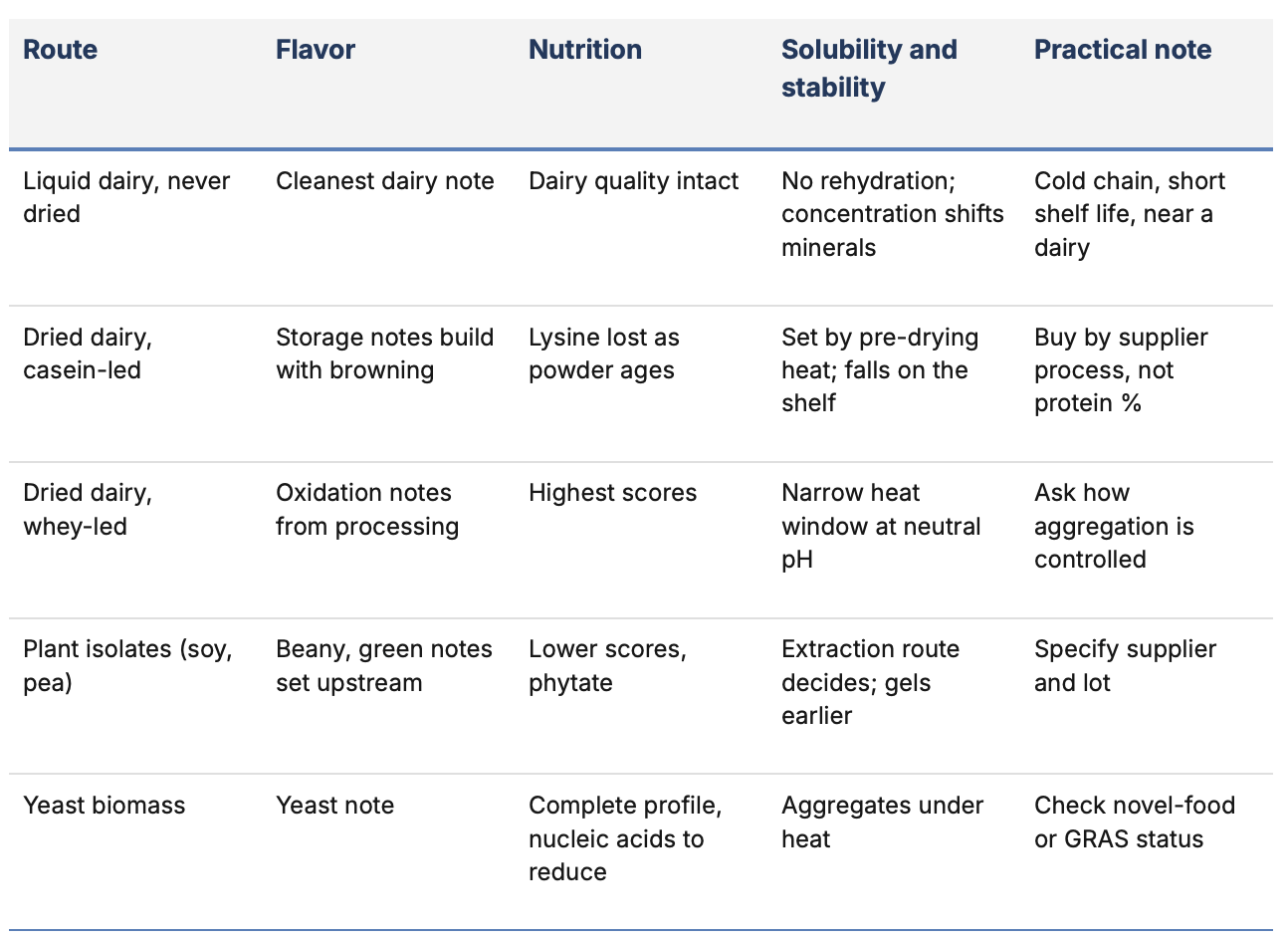
This article evaluates four supply routes across these three criteria: liquid dairy proteins (ultrafiltered milk and micellar casein concentrate), dried casein-dominant powders (MPC and MPI), dried whey-dominant powders (WPI and WPC), and plant/biomass isolates (soy, pea, and yeast).
Flavor profile is established upstream
When selecting a protein, formulators typically evaluate flavor first, as it is the most directly sensory property. Dairy and plant proteins can both carry off-notes from oxidation, extraction, storage, pH, and light exposure—defects that originate prior to bench evaluation.
Whey is a clear example. For instance, every step between cheese vat processing and spray drying can accelerate lipid oxidation, with bleaching to strip cheese colorant being a primary driver. The stale, cardboard-like off-note in stored whey protein stems from these oxidation products and continues to intensify during storage [2].
Plant proteins exhibit similar behavior. Over a year of storage, shifts in pea protein volatiles correlate so closely with sensory panel perception that GC-MS analysis can detect emerging off-flavors before human panels [3]. Hexanal and related green or beany notes generated by endogenous enzymes and oxidation are already fixed by the time the isolate arrives.
While masking agents mitigate off-notes, they increase costs, elevated flavor loads, and lengthen ingredient lists. Selecting a protein with an acceptable baseline flavor profile remains the most economical approach.
Flavor is an accessible initial screening tool, but the remaining two criteria are not captured by basic sensory testing or standard specification sheets.
Nutrition arrives with the source, and some of it leaves in storage
DIAAS, or Digestible Indispensable Amino Acid Score, scores protein quality by how well its digestible essential amino acids match the FAO reference pattern*. A score of 100 or higher indicates complete coverage, while scores below 100 are limited by whichever amino acid falls short first. Dairy proteins clear this threshold, whereas soy and pea fall short on sulfur amino acids (methionine and cysteine). The table below lists values from a study evaluating all five ingredients under identical conditions [4].
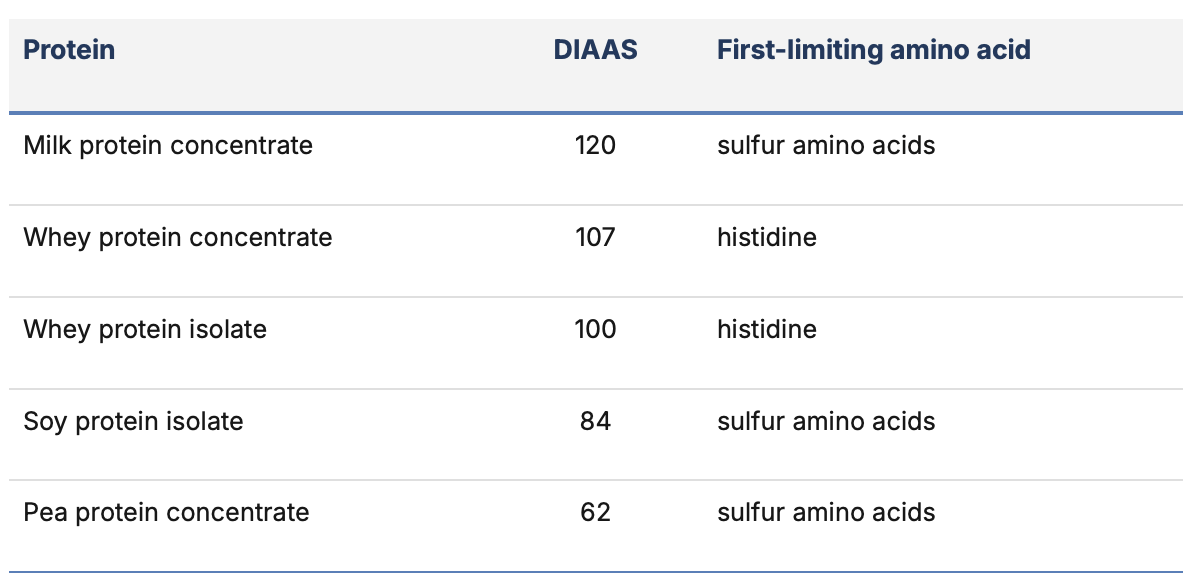
*Scored against the FAO reference pattern for children aged 6 months to 3 years, the most demanding pattern in common use.
Pea is rich in lysine, the amino acid cereals lack, so in this case a pea and cereal blend covers each partner’s gap. This formulation lever is directly governed by protein source selection.
Additionally, plant isolates contain phytate, which binds minerals such as calcium, iron, and zinc. In pea or faba protein dispersions near neutral pH, phytate-protein-mineral complexes fluctuate between soluble and insoluble states, potentially causing added minerals to precipitate [5]. Phytate content is determined by supplier extraction methods.
Third is storage. As milk protein powders age, Maillard browning reduces both solubility and digestible lysine, lowering the powder's actual nutritional value relative to its original lot analysis [6]. Like flavor, nutrition depends on process history.
Yeast biomass protein offers a complete amino acid profile, but requires nucleic acid reduction prior to practical commercial use.
Solubility and stability set the size of the formulation problem
Solubility and stability dictate necessary stabilizer support across three distinct stages.
Getting the protein into water
Liquid dairy proteins eliminate rehydration challenges because casein micelles remain un-dried.
Drying is where the trouble starts. The heat treatment a manufacturer applies to the liquid concentrate before drying improves the powder’s heat stability, which a UHT beverage wants, and at the same time makes the powder harder to disperse, which it does not [7]. These two properties trade off long before formulation starts.
Furthermore, solubility decreases during storage due to ongoing browning reactions and protein cross-linking [6].
Plant isolates add supplier-to-supplier variation on top. A study of ten commercial pea protein isolates found material differences in solubility, particle size, viscosity and heat response, all traced to extraction route, drying history and pH exposure prior to packaging [8]. “Pea protein isolate” names an ingredient family, not a single material.
Keeping it there through heat
Lacking a protective micelle, whey proteins have a narrow heat stability window sensitive to pH, concentration, and minerals. In a pilot study, whey protein isolate at pH 6.2 showed increased denaturation and aggregation compared to pH 6.7 or 7.2, gelation occurred at 12% protein at pH 6.2 [9]. Some suppliers mitigate this by pre-forming soluble aggregates prior to drying—a process control buyers should verify.
Plant proteins reach their gel point sooner than milk proteins at the same use level, and soy behaves differently again depending on which of its protein fractions dominates and how much heat it saw before you bought it.
Dairy and plant protein blends form unique systems with distinct heat aggregation behaviors, requiring testing under intended processing conditions rather than theoretical prediction [10].
The mineral system it brings along
Casein-rich proteins contain micellar calcium phosphate. Concentration and drying alter this equilibrium, often requiring stabilizing salts or chelators (e.g., citrate or polyphosphate) to restore heat stability and clarity. However, these additives influence viscosity, particle size, flavor, and labeling [11].
Plant isolates supply phytate, which alters interactions between calcium, salts, and protein near neutral pH [5].
The four routes, side by side
What is left to formulate
Once a source is selected, formulation options vary across the three lenses:
Flavor is largely predetermined. Masking systems can mitigate off-notes, but cannot eliminate defects introduced during drying.
Nutrition can be modified through blending and fortification, subject to phytate levels and ingredient age.
Stability provides the most formulation flexibility. Mineral balance, hydration, particle behavior, heat response, and shelf life can be optimized through formulation, process design, and hydrocolloid selection.
SeaTex addresses this third area by supporting suspension, texture, emulsification and pH control in protein beverages, though proper ingredient selection remains foundational.
When evaluating ingredients, follow this protocol: evaluate flavor at target usage levels and pH; review DIAAS, phytate content, and lot age; then assess hydration, heat stability, mineral profile, viscosity, and shelf life.
Contact our technical team to discuss stabilization strategies tailored to your specific protein system.
Marine Biologics develops SeaTex, a seaweed-based multifunctional, clean-label stabilizer, with desired processability, for high-protein food and beverage applications. The team focuses on protein behavior from ingredient sourcing through shelf life. For technical discussion, contact@marinebiologics.com.
SOURCES
Verkempinck, S., Duijsens, D., Mukherjee, A., & Wilde, P. J. (2024). Pea protein extraction method impacts the protein (micro)structural organisation and in vitro digestion kinetics. Food & Function. https://doi.org/10.1039/d3fo04225a
Carter, B., & Drake, M. (2018). Invited review: The effects of processing parameters on the flavor of whey protein ingredients. Journal of Dairy Science. https://doi.org/10.3168/jds.2018-14571
Fischer, E., Cachon, R., & Cayot, N. (2022). Impact of Ageing on Pea Protein Volatile Compounds and Correlation with Odor. Molecules. https://doi.org/10.3390/molecules27030852
Mathai, J. K., Liu, Y., & Stein, H. H. (2017). Values for digestible indispensable amino acid scores (DIAAS) for some dairy and plant proteins may better describe protein quality than values calculated using the concept for protein digestibility-corrected amino acid scores (PDCAAS). British Journal of Nutrition. https://doi.org/10.1017/S0007114517000125
Amat, T., Assifaoui, A., Buczkowski, J., Silva, J. V., Schmitt, C., & Saurel, R. (2023). Interplay between soluble and insoluble protein/calcium/phytic acid complexes in dispersions of faba bean and pea protein concentrates around neutral pH. Food Hydrocolloids. https://doi.org/10.1016/j.foodhyd.2023.109273
Szołtysik, M., Dibagar, N., Słupska, M., Serowik, M., Gryszkin, A., & Figiel, A. (2026). Physical Instability and Functional Deterioration of High-Protein Dairy Powders: Mechanisms of Caking, Agglomeration, and Rehydration Loss. Molecules. https://doi.org/10.3390/molecules31132230
McSweeney, D. J., Aydogdu, T., Hailu, Y., O’Mahony, J. A., & McCarthy, N. A. (2022). Heat treatment of liquid ultrafiltration concentrate influences the physical and functional properties of milk protein concentrate powders. International Dairy Journal. https://doi.org/10.1016/j.idairyj.2022.105403
Schumacher, T., Steinmacher, T., Köster, E., Wagemans, A. M., Weiß, J., & Gibis, M. (2025). Physico-chemical characterization of ten commercial pea protein isolates. Food Hydrocolloids. https://doi.org/10.1016/j.foodhyd.2024.110996
Buggy, A. K., McManus, J. J., Brodkorb, A., Hogan, S. A., & Fenelon, M. A. (2018). Pilot-scale formation of whey protein aggregates determine the stability of heat-treated whey protein solutions: Effect of pH and protein concentration. Journal of Dairy Science. https://doi.org/10.3168/jds.2017-14177
Nascimento, L. G. L., Odelli, D., Carvalho, A. F. d., Martins, E., Delaplace, G., Júnior, P. P. d. S. P., Silva, N. F. N., & Casanova, F. (2023). Combination of Milk and Plant Proteins to Develop Novel Food Systems: What Are the Limits? Foods. https://doi.org/10.3390/foods12122385
Choi, I., & Zhong, Q. (2020). Physicochemical properties of skim milk powder dispersions prepared with calcium-chelating sodium tripolyphosphate, trisodium citrate, and sodium hexametaphosphate. Journal of Dairy Science. https://doi.org/10.3168/jds.2020-18644