
FROM POND BACTERIA TO GLOBAL FOOD STABILIZER TECHNOLOGY
I. THE ACCIDENTAL ISOLATE
The narrative of gellan gum serves as a valuable case study in the evolution of the hydrocolloid industry and industrial fermentation, tracing the path from an accidental microbial isolate to a globally industrialized food stabilizer (E418). Identified in 19781 by researchers at a San Diego-based kelp processing firm, this opportunistic finding in a pondweed sample would eventually form the basis for a versatile tool in modern food science—one whose very success in providing supply security now positions it in tension with the growing demand for minimal processing and "clean-label" ingredients.
II. THE MARKET IMPERATIVE

Wild kelp harvester operated by Kelco off the California coast in 1978.
Kelco, established in 19292, had long maintained a dominant position in the production of alginates from wild seaweed harvested from the massive kelp forests growing in the open oceans off the coast of southern California3.
However, by the 1970s, the company faced inherent challenges regarding the predictability of raw materials sourced from the wild. The harvesting of wild kelp was subject to environmental variables, including storms and biological cycles, which resulted in inconsistent supply and pricing.
(note: in a future post, we will be exploring the hardening of kelp supply chains over the past 50 years with industrial aquaculture; it’s great stuff, stay tuned!)
Following its successful industrialization of xanthan gum the previous decade4, Kelco sought to develop a new ingredient portfolio derived from microbial fermentation. This method offered the advantage of a controlled manufacturing environment, providing a more deterministic alternative to the open-ocean harvesting of wild marine life.
The objective was to identify a microorganism capable of secreting a polysaccharide with superior gelling properties. Scientists conducted extensive environmental surveys, screening diverse microbial populations for biological engines that could be scaled for industrial applications.
III. A STICKY BACTERIA
The key breakthrough involved the study of Elodea canadensis5, a resilient and widely distributed pondweed.
A Kelco R&D team, led by Kenneth Kang and George Veeder, discovered that the surface of the plant hosted a bacterial biofilm characterized by its high-performance adhesive properties. This sticky polysaccharide had evolved to allow the bacteria to remain attached to surfaces within aquatic environments.
The organism responsible was later identified as Sphingomonas elodea. Its industrial potential was recognized well before the formal scientific nomenclature was fully established in 19906. Before the world knew its name, it was simply a Sphingomonas variant waiting for its moment to redefine the architecture of food.
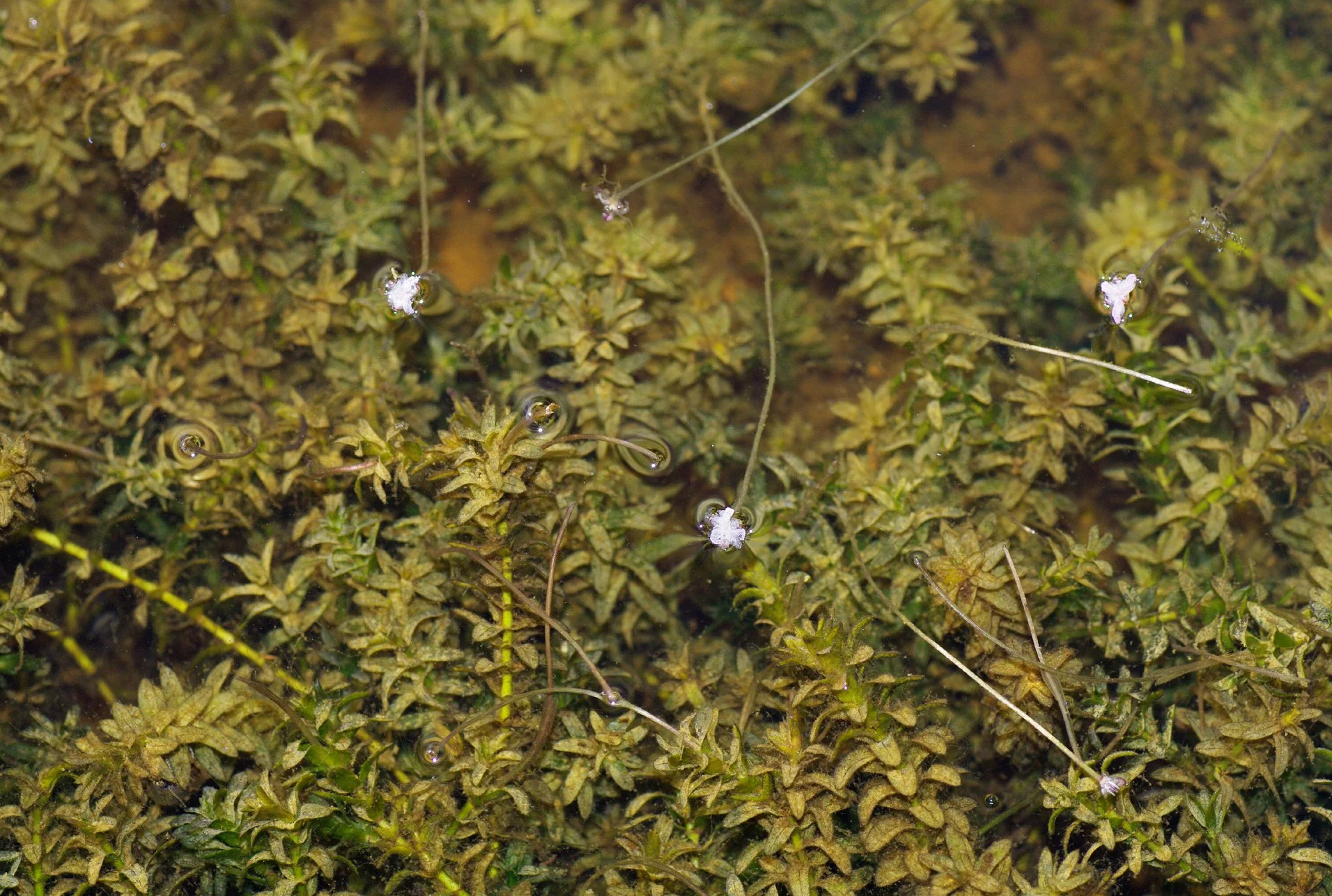
Elodea canadensis in Lake Michigan.
IV. MOLECULAR ARCHITECTURE
Sphingomonas elodea is an oxygen-respiring bacterium (aerobe) that possesses a unique outer surface. While most similar bacteria have a sugary outer coat, Sphingomonas instead has a naturally greasy surface made of fatty molecules called glycosphingolipids.
This greasy texture is what allows the bacterium to stick to the waxy leaves of aquatic plants. The adhesion occurs through a natural process similar to how oil and water separate: because water avoids non-polar surfaces, the greasy patches on both the bacteria and the leaf are naturally pushed together until they aggregate.
Importantly, Sphingomonas secretes a polysaccharide, a hydrocolloid now called gellan gum, that functions as a protective layer and as an additional adhesive in river currents. This evolutionary adaptation resulted in a material with exceptional structural integrity, which food scientists would later leverage for stabilizing complex liquids like plant-based milks and coffee drinks.
By 1982, the industrial viability of the product was secured. The same team obtained a foundational US patent for the agar-like polysaccharide1, introducing a new standard for high-clarity, high-strength gels to the scientific and industrial communities.
V. SCALING THE MONOCULTURE
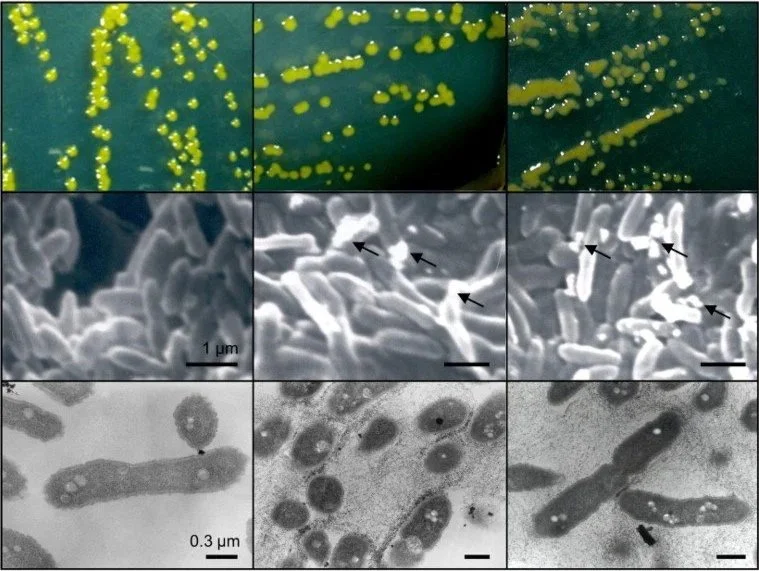
Phenotype comparison of S. elodea strains: (A) colony morphology, (B) SEM, and (C) TEM imagery, highlighting extracellular gellan secretion.
Modern production involves a precise biotechnological process: the microbe is fermented in stirred tanks at 30°C for approximately forty-eight hours9, the cells are killed, the polysaccharide is precipitated with isopropanol or ethanol, and the result is dried and milled into a stable powder. In the US, gellan is designated as an "additive". The EU designates it as E418, an approved food additive across sixty-seven categories10.
Notably, the global supply of gellan gum remains derived from the specific bacterial strain ATCC 3146110. One bacterial isolate, recovered from one Elodea sample in one pond, has been cloned and propagated through every food-grade gellan fermenter in the world for four decades. Global production now runs at industrial scale, more than 10,000 metric tons annually, with CP Kelco (the direct corporate descendant of the original Kelco) controlling roughly 22% of supply11.
VI. MICROBIAL FOOD PRODUCTION IN THE CLEAN-LABEL ERA
The industrialization of this single bacterial strain highlights a fundamental tension in modern food technology. While the controlled fermentation process provides supply security, the resulting product—a refined chemical precipitated by alcohol—increasingly conflicts with growing consumer demand for ingredients that are minimally processed and easily recognizable.
Clean-label ingredients are designed to simplify declaration lists and restore consumer confidence with recognizable components. Gellan gum faces some headwinds because:
It is commonly paired with other declared chemicals, extending label declarations.
Its lack of familiarity—it cannot be found in nature or a typical kitchen—and its origin as a bacterial secretion can reduce consumer appeal.
The chemical precipitation process may cause gellan gum to be associated with the prevailing negative perception of ultra-processed foods (UPFs).
The story of gellan gum, from a simple bacterial adhesive on a pondweed to a globally industrialized food stabilizer (E418), is a testament to the power of microbial fermentation in creating a deterministic supply chain. Yet, this very success—the replication of a single patented bacterial strain and the chemical refinement of its secretion—highlights a tension in modern food technology. Gellan gum offers undeniable functional integrity and supply security, but its classification as an additive and its distance from any recognizable whole food source create challenges in a clean-label era.
To learn more about gellan gum and how it compares to SeaTex™, our formulation agent is available 24/7 to answer your questions.
SOURCES
1. Kang KS, Veeder GT, Mirrasoul PJ, Kaneko T, Cottrell IW (1982). Agar-like polysaccharide produced by a *Pseudomonas* species: production and basic properties. Applied and Environmental Microbiology 43(5):1086–1091. https://journals.asm.org/doi/10.1128/aem.43.5.1086-1091.1982
2. CP Kelco, Our History. https://www.cpkelco.com/about-cp-kelco/our-history/
3. San Diego Reader, "The Forests Below" (Nov 9, 1978). https://www.sandiegoreader.com/news/1978/nov/09/cover-the-forests-below/
4. Cape Crystal Brands, The Complete History of Xanthan Gum. https://www.capecrystalbrands.com/blogs/cape-crystal-brands/the-complete-history-of-xanthan-gum-from-accidental-discovery-to-global-industry-standard
5. Elodea canadensis — Wikipedia. https://en.wikipedia.org/wiki/Elodea_canadensis
6. Aali RAKA, Al-Sahlany STG (2024). Sustainability in the Production of Gellan Gum From Sphingomonas Species. IOP Conf. Ser.: Earth Environ. Sci. 1371:062014. https://doi.org/10.1088/1755-1315/1371/6/062014
7. ScienceDirect Topics, Sphingomonas (overview). https://www.sciencedirect.com/topics/agricultural-and-biological-sciences/sphingomonas
8. Vacheron J, Heiman CM, Keel C (2019). A modular atomic force microscopy approach reveals a large range of hydrophobic adhesion forces among bacterial members of the leaf microbiota. ISME Journal 13(7):1878–1882. https://pmc.ncbi.nlm.nih.gov/articles/PMC6591122/
9. Sukumar S, Arockiasamy S, Moothona MC (2021). Optimization of cultural conditions of gellan gum production from recombinant Sphingomonas paucimobilis ATCC 31461 and its characterization. J Appl Biol Biotechnol 9(1):58–67. https://doi.org/10.7324/JABB.2021.9108
10. EFSA ANS Panel (2018). Re-evaluation of gellan gum (E 418) as food additive. EFSA Journal 16(6):5296. https://doi.org/10.2903/j.efsa.2018.5296
11. Market Growth Reports, Gellan Gum Market Size, Share, Trends | Growth Report, 2035. https://www.marketgrowthreports.com/market-reports/gellan-gum-market-116069